 Aguas Calientes City Guide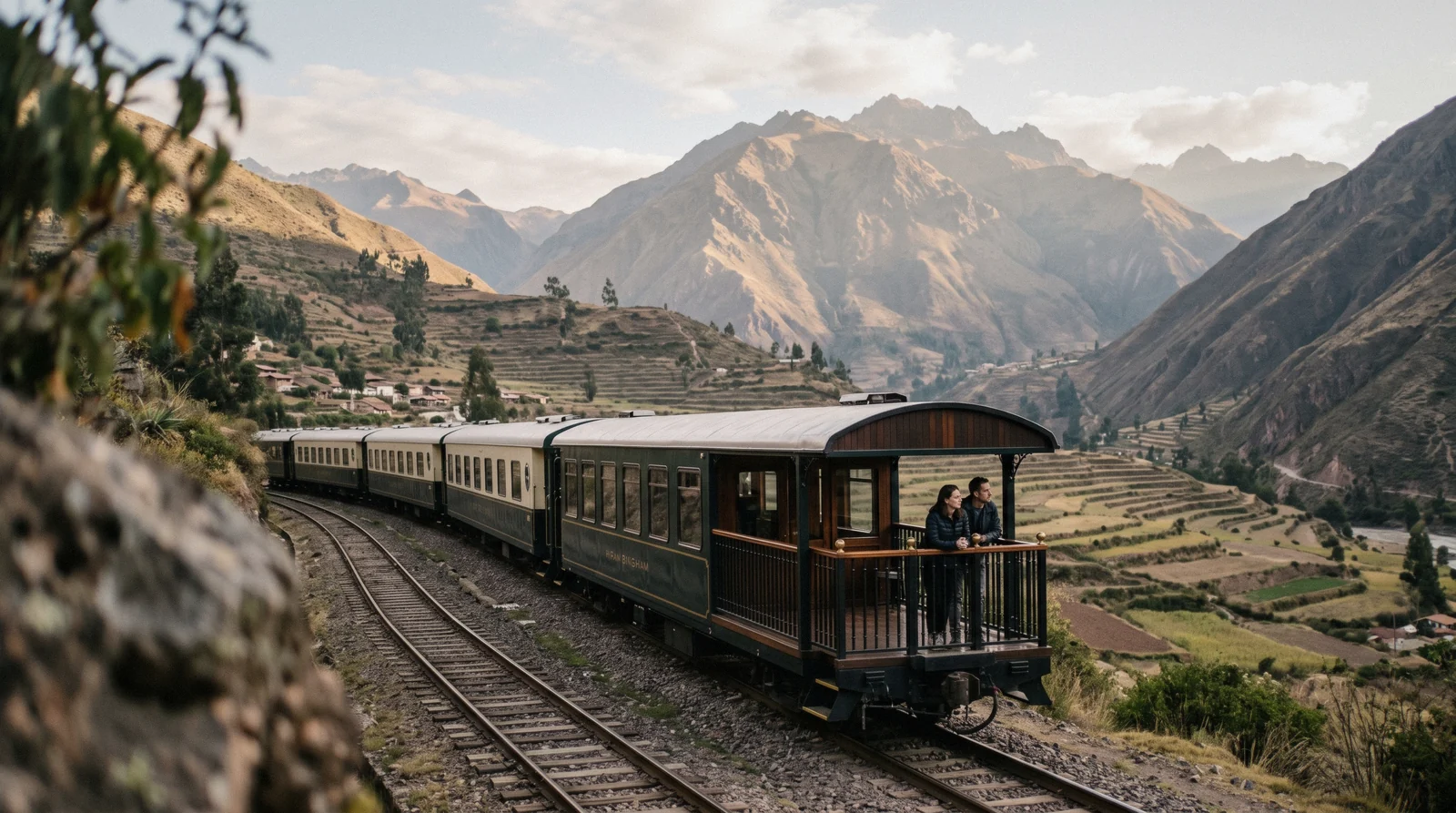
The Hiram Bingham Train: Belmond's Luxury Service to Machu Picchu
The Hiram Bingham train is a separate luxury service, operated by Belmond, that runs on PeruRail's tracks between the Cusco area or the Sacred Valley and Machu Picchu (Aguas Calientes) station. This page covers what the Hiram Bingham train's fare includes; for the standard-service alternative see PeruRail, and for the wider overview see train to Machu Picchu.
Quick answer What the fare includes and what it does not
The Hiram Bingham is Belmond's luxury train to Machu Picchu. It departs from Poroy station (Cusco), Rio Sagrado station (Urubamba) or Pachar station (Sacred Valley) and runs to Machu Picchu (Aguas Calientes) station. It carries only 84 passengers, serves a light lunch outbound and a gourmet dinner on the return, and includes a private bus transfer from Aguas Calientes station to the citadel entrance. The Machu Picchu entrance ticket is not automatically included in the fare.
Key takeaways
- Belmond does not publish a fixed public fare in what was fetched for this guide. Check belmond.com for the current rate.
- The fare includes the train, meals, entertainment, a bilingual guide at Machu Picchu subject to availability, and the bus from Aguas Calientes station up to the citadel entrance.
- The Machu Picchu entrance ticket is managed separately by Peru's Ministry of Culture, see Machu Picchu tickets.
- For a standard-service alternative see the PeruRail page, or for a fixed-price budget option see Trip Tour's train to Machu Picchu at US$130.00.
What the Hiram Bingham Is
The Hiram Bingham is Belmond's luxury train to Machu Picchu. It is named after the American explorer Hiram Bingham, who brought the site to international attention in the early twentieth century. The train is operated by Belmond and runs on tracks owned by PeruRail, which lists Belmond Trains as part of its network.
It is nonetheless a separate product from PeruRail's own services. If you are comparing options, the distinction matters: PeruRail sells its own Expedition, Vistadome and Vistadome Observatory services directly, and those are covered on the PeruRail page. The Hiram Bingham sits above them as a full-day, all-inclusive experience rather than a point-to-point transfer.
The clearest sign of what kind of journey this is comes down to a single number. The train carries 84 passengers. PeruRail's Expedition carriages and Inca Rail's Voyager carriages carry far more people per departure, and the whole onboard rhythm changes as a result.
With 84 guests the Hiram Bingham runs two dining cars and two bar cars for a small group, with staff serving a seated meal rather than handing out snacks. You are buying a long, slow day of food, music and scenery wrapped around a train ride, not just transport to the ruins.
It is also worth being clear about what the fare covers and what it does not. The ticket includes the train itself, meals and drinks onboard, live entertainment, the private bus transfer between Aguas Calientes station and the citadel entrance, a bilingual tour guide at the site subject to availability, and on the outbound journey a tea-time sitting at the Sanctuary Lodge, also subject to availability. It does not automatically include the Machu Picchu entrance ticket.
That ticket is managed separately by Peru's Ministry of Culture, and you need to arrange it yourself. Our guide to Machu Picchu tickets explains how to buy one. If you are weighing the Hiram Bingham against the standard trains, the general train comparison and the page on PeruRail versus Inca Rail cover the cheaper tiers in detail, and Inca Rail's own services sit between the entry-level and luxury ends of the market.
Route and Departure Stations
The Hiram Bingham departs from three possible stations. From Cusco it leaves Poroy station, on the outskirts of the city. From the Sacred Valley it can depart from Rio Sagrado station in Urubamba or from Pachar station.
All three departures run to the same destination: Machu Picchu station in Aguas Calientes, the small town at the base of the mountain. The town, officially called Machupicchu Pueblo, and the station sit at about 2,040 m. The Machu Picchu gate itself is at 2,430 m, which is why no train reaches the citadel directly and why the last stretch is always by road.
That last stretch is where the Hiram Bingham differs from a bare train ticket. When you arrive at Aguas Calientes station, a private bus transfer is included in the fare and takes you from the station up to the citadel entrance. Travellers on standard services buy that bus ride separately, usually from the Consettur counter by the river.
With this train it is already handled. For background on how that bus leg works for everyone else, see the Aguas Calientes bus page or the fuller route description in Aguas Calientes to Machu Picchu.
Choosing a departure station is mostly a question of where you slept the night before. Poroy serves travellers staying in Cusco itself. Rio Sagrado and Pachar suit people who have based themselves in the Sacred Valley to acclimatise at a lower altitude.
Whichever station you use, the journey ends in the same river gorge at the foot of the ruins, and the return leg brings you back down the same line to your starting station in the evening, with dinner served onboard as you go.
Onboard the Train
The train carries 84 passengers across six cars worth of public space: two dining cars and two bar cars, plus an open-air observation car with panoramic views. The observation car is the one that sells the route. The line climbs out of the high plateau, drops through the Sacred Valley and then descends into the cloud forest along the Vilcanota river, and the scenery in the final hour is arguably better than anything visible through a window seat.
Standing in the open air while the walls of the gorge close in is the part of the day most riders remember.
The service is Peruvian fine dining, with local and international cocktails from the bar. On the outbound leg you get a light lunch, since most of the day at Machu Picchu still lies ahead. On the return leg the meal is a gourmet dinner, served while the train works its way back up the valley in the dark.
Live musical performances and regional dancers move through the cars during the journey. It is closer to an evening out than a commute, and the pace of the day reflects that.
Two inclusions at the far end are worth flagging, with a caveat attached to both. The fare includes a bilingual tour guide at Machu Picchu, subject to availability, and on the outbound journey a tea-time sitting at the Sanctuary Lodge, the hotel beside the citadel entrance, also subject to availability. The phrase subject to availability is Belmond's own, so treat both as likely but not guaranteed when you plan your day.
If you are arranging your own entrance ticket, remember that your entry slot and your circuit determine what you can see at the site. Our Machu Picchu tickets page explains the circuit system, and things to do in town covers the rest of the day if your visit ends early.
Booking and What It Costs
The honest answer on price is that Belmond does not publish a fixed public fare in what was fetched for this guide. Luxury-train pricing changes with season and route, and the Hiram Bingham is no exception. To find the current rate, check belmond.com directly and search your own travel dates, since the same journey can be priced differently depending on the departure station and the time of year.
Do not assume a figure quoted by a third-party site months ago still applies.
When you do book, budget separately for the Machu Picchu entrance ticket. It is managed by Peru's Ministry of Culture, sold through its own platform, and is not automatically included in the Hiram Bingham fare. It is date-specific and capacity-limited, so buy it before or at the same time as the train, not after.
Our Machu Picchu tickets guide walks through the process.
If the fare comes back higher than you want to spend, you have two realistic alternatives. On the same tracks, PeruRail's own Expedition, Vistadome and Vistadome Observatory services cost less and are described on the PeruRail page. For a budget option at a different service level, Trip Tour's train to Machu Picchu is bookable at $130.00 for a 3h 30m scenic ride from Cusco toward Aguas Calientes with pickup included, full refund if cancelled at least 24 hours ahead, and limited availability on this route.
Note that this is transport only, with no entrance ticket included.
A Fixed-Price Alternative
We do not sell a Hiram Bingham ticket. Our own bookable train card, at a standard service level, is a fixed-price alternative.
 from $130.00
Train to Machu Picchu
Trip Tour books the scenic train ride from Cusco toward Aguas Calientes, the gateway to Machu Picchu, with pickup included. Cancel up to 24 hours ahead for a full refund, and note that availability is limited on this route.
Check AvailabilityPrices, ratings and details are the platform's own. Dollar figures are the listed prices. The platform bills in your account's currency.
Related Pages
Machu Picchu Tickets
The entrance ticket, bought separately from any train fare.
Hiram Bingham Train: Questions
Is the Belmond train to Machu Picchu the same as the Hiram Bingham?
Yes. The Belmond Hiram Bingham is the luxury train Belmond operates to Machu Picchu. It runs on PeruRail's own tracks, which list Belmond Trains as part of their network, but it is a separate Belmond-operated product from PeruRail's Expedition, Vistadome and Vistadome Observatory services.
Where does the Hiram Bingham train depart from?
It departs from Poroy station in Cusco, Rio Sagrado station in Urubamba, or Pachar station in the Sacred Valley, and runs to Machu Picchu (Aguas Calientes) station. The station and town sit at about 2,040 m, while the citadel gate is at 2,430 m, so the final leg up is by bus.
What makes the Hiram Bingham different from the standard trains to Machu Picchu?
It carries just 84 passengers, has two dining cars, two bar cars and an open-air observation car, and serves Peruvian fine dining with a light lunch outbound and a gourmet dinner on the return. Live musicians and regional dancers perform onboard. The fare also includes the private bus from Aguas Calientes station to the citadel entrance, a bilingual guide at the site subject to availability, and on the outbound journey a tea-time sitting at the Sanctuary Lodge, subject to availability. Standard trains are point-to-point transport.
Does the Hiram Bingham fare include the Machu Picchu entrance ticket?
No. The entrance ticket is managed separately by Peru's Ministry of Culture and is not automatically included in the fare. You need to buy it yourself, and our Machu Picchu tickets page explains how.
How much does the Hiram Bingham cost?
Belmond does not publish a fixed public fare in what was fetched for this guide. Pricing changes with season and route, so check belmond.com for the current rate on your dates. If it is out of budget, PeruRail's standard services are the mid-range alternative, and Trip Tour's train to Machu Picchu is bookable at $130.00.
See the Hiram Bingham Before You Book
Ride reports covering the onboard experience and whether it is worth the fare.
A Voyage to the Heart of the Inca Empire
Belmond's own look at the Hiram Bingham journey.
Video: BelmondHiram Bingham Train to Machu Picchu Is Amazing, Although It Will Cost You
An independent review weighing the experience against the price.
Video: Jonathan PetramalaLuxurious Train Ride to Machu Picchu: Is It Worth the Cost
A traveller's honest verdict after riding the Hiram Bingham.
Video: Living JetsettersPrices, hours and terms are set by the venue or operator and confirmed at checkout.
We may earn a commission if you book through one of our links, at no extra cost to you. Full affiliate disclosure