 Aguas Calientes City Guide
The Inca Trail to Machu Picchu: Permits, Fees and the Route
The Inca Trail to Machu Picchu is the classic 4-day, 33.7 km hiking route from Piscacucho (km 82) to the ruins, finishing through the Sun Gate. It sits inside SERNANP's Historic Sanctuary of Machupicchu, and you cannot hike it independently: every trekker books through a SERNANP-licensed agency with a guide, permits are capped at 500 a day, and the best dates sell out months ahead. See treks to Machu Picchu for the other four routes if this one does not fit your dates.
Quick answer Permits, fees and how far ahead to book
The classic Inca Trail is a 4-day, 33.7 km hiking route from Piscacucho (km 82) to Machu Picchu, finishing through the Sun Gate. Only 500 permits are issued per day, about 200 of them for trekkers, and each one is tied to a passport. The SERNANP Route 1 fee is US$86.00 (S/292) per adult, always bundled into the agency's tour price. Permits release each October and the best dates sell out months ahead.
Key takeaways
- One card here is the real classic route: the 4-day Inca Trail hike with the Vistadome train back at US$798.00.
- Only have 2 days? The short Inca Trail from km 104 reaches the same Sun Gate finish.
- Permits gone for your dates? The uncapped Salkantay trek is the fallback with no SERNANP permit needed.
Key facts
Opening hours
| Trail network entry | 05:30–14:00 |
|---|
Closed Every February, for maintenance
Admission
- Adult
- US$86.00 (S/292), bundled into the licensed agency's tour price
- Reduced
- Students US$43.30 (S/147), schoolchildren US$39.70 (S/135)
Planning it
- Time needed
- 4 days point to point
- Book ahead
- Essential — weeks ahead
- Address
- Piscacucho (Km 82), Ollantaytambo District, Urubamba Province, Cusco Region, Peru
Booking the Classic Inca Trail
There is no stand-alone Inca Trail permit you can buy. SERNANP sells entry to the trail network only through its licensed agencies, so your permit, the Machu Picchu Llaqta entrance ticket and the guided service arrive as one bundle in the tour price. TreXperience's card below is the true classic route on this page.
Are you set on 4 days and the classic route, or would 2 days to the same Sun Gate work? The short route is a different trek, covered on its own page.
| Tour | Duration | Price | Notes | Book |
|---|---|---|---|---|
| 4-Day Inca Trail Hike & Panoramic TrainTrekkers with 4 days who want the full classic route to the Sun Gate | 4 days | US$798.00 | Small group capped at 16, premium tents and cooked meals, returns on the Vistadome train. Rated 4.9 from 591 reviews. | Check Availability |
Figures current in Q3 2026. Only have 2 days? See the short Inca Trail from km 104, a different route with its own page.
The Card That Is the Real Classic Route
Some products titled "Inca Trail" are actually biking and jungle routes, so read the description before you pay. This is the only card on this page that walks the real classic trail through the Sun Gate.
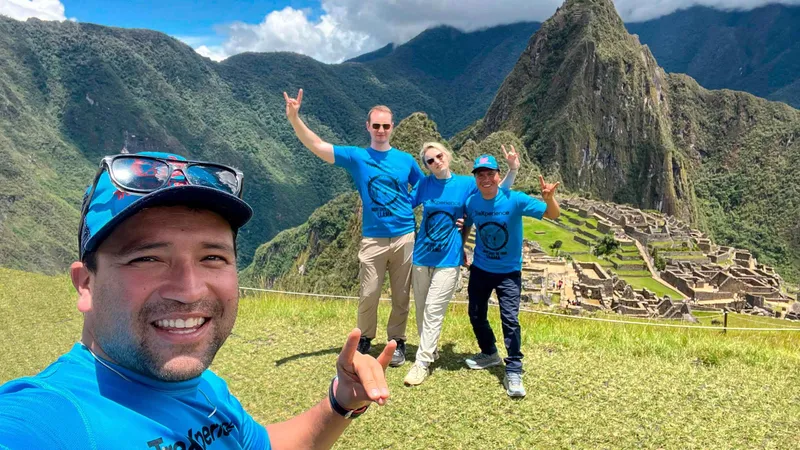 from $798.00
Machu Picchu: 4-Day Inca Trail Hike & Panoramic Train
TreXperience hikes the classic Inca Trail through the Sun Gate, with premium tents, cooked meals and a small group capped at 16, then returns to Cusco on the scenic Vistadome train. The operator also runs a project supporting women porters and gender equality on the trail.
Check AvailabilityPrices, ratings and details are the platform's own. Dollar figures are the listed prices. The platform bills in your account's currency.
The Trail Day by Day
SERNANP describes Route 1, the Main Inca Trail, as starting at Piskacucho (km 82) and running 33.7 km through Meskay, Willkarakay, Tarayoq and Wayllabamba before the pass at Warmiwañusqa. The elevation profile below comes from Wikipedia's trail article. Total time on the route is 4 days point to point.
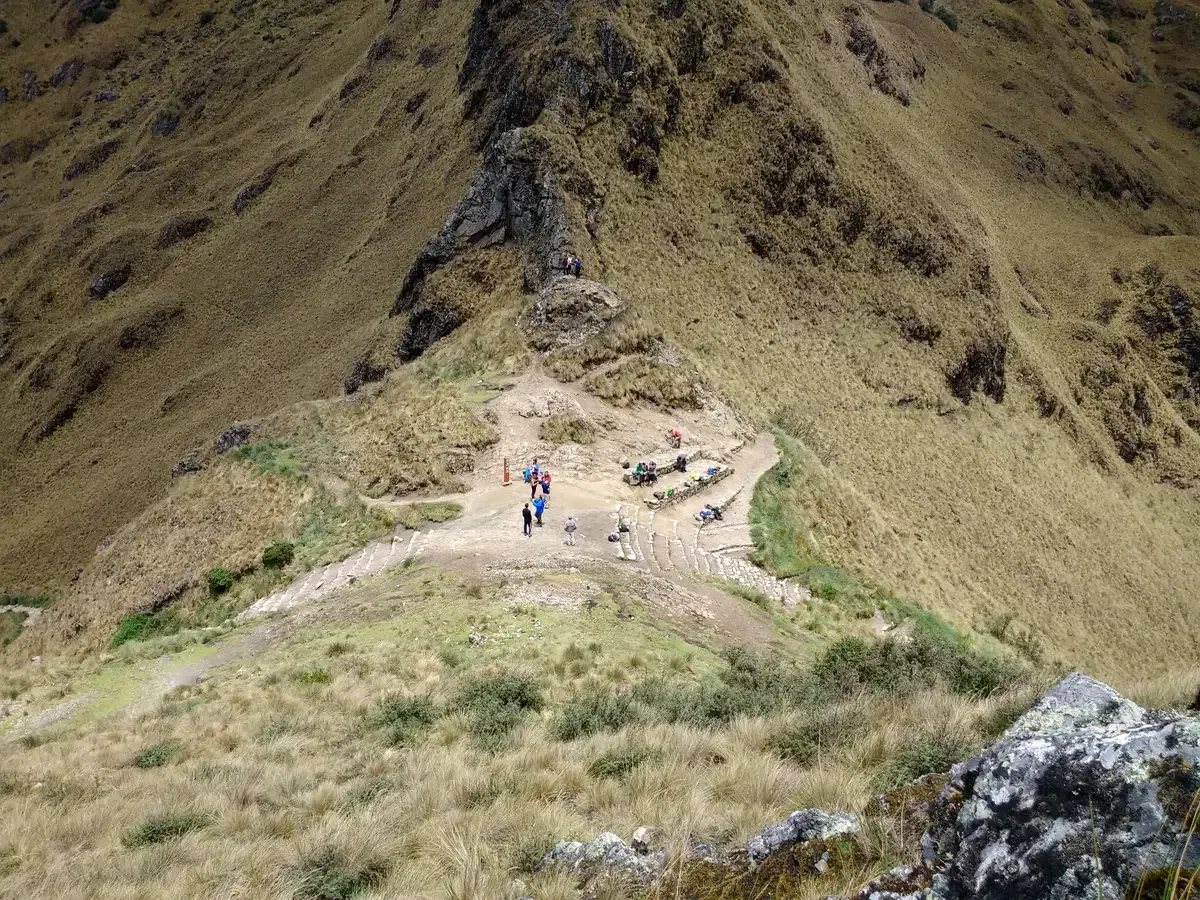
The Inca Trail near Dead Woman's Pass. Photo: Mx._Granger, CC0, via Wikimedia Commons
Getting to the Start at Km 82
The trailhead at Piscacucho, better known as km 82, is not walkable from Cusco. SERNANP's access table gives the Cusco to Piscacucho leg as 85 km by tourist-agency bus, about 2 hours 30 minutes. The licensed agency includes this transfer, and the permit checkpoint at the trailhead checks each passport against the permit list.
The practical line: arrive with the exact passport you booked with, since the permit is not transferable. Spending a night in the Sacred Valley first? Ollantaytambo sits on the way and cuts the morning drive. Altitude at the start is about 2,600 m, so acclimatise in Cusco first and read the altitude guide before committing.
Day One: Piscacucho to Wayllabamba
Day one starts around 2,600 m and climbs to about 3,300 m, following the route through the Meskay, Willkarakay and Tarayoq sectors to Wayllabamba. It is the gentlest day, meant to shake out legs and let guides set the pace. Camp sits at or near Wayllabamba, the last village sector before the big climb.
The practical line is to drink more water than feels necessary, because day two collects the altitude's dues. SERNANP's own temperature note for the Inca Trail is 5C to 18C, so pack for cold nights even in the dry season.
Day Two: Dead Woman's Pass at 4,215 m
Day two crosses Abra de Warmiwañusqa, Dead Woman's Pass, at 4,215 m, the highest point on the trail. It is a long ascent from Wayllabamba that most trekkers call the hardest morning of the four days. After the pass the trail descends to about 3,600 m.
Weather above 4,350 m in the sanctuary runs 1.5C to 3C on SERNANP's own figures, so windproof layers matter at the summit even under blue sky. The practical line is to start slow and let porters pass, since they carry camp gear and duffels at a pace tuned to the altitude. This pass is why the classic trail counts as a demanding multi-day hike rather than a walk.
Day Three: Runkuraqay, Sayaqmarka and the 1,500 Steps
Day three crosses a second pass near Runkuraqay at roughly 3,750-3,950 m, then continues down through the Sayaqmarka and Phuyupatamarka sectors. At Phuyupatamarka the trail drops about 1,000 m on roughly 1,500 steps, hard on knees and the reason trekking poles are standard kit. Camp on this stretch sits near Wiñay Wayna, the last site before Machu Picchu.
The practical line: wrap or brace your knees if you have any history of trouble, since the steps are relentless and wet in the rainy season from November to March. This is also the day that visits the most Inca ruins in sequence.
Day Four: Wiñay Wayna, the Sun Gate and Machu Picchu
The final morning runs from Wiñay Wayna below the ridge of the mountain named Machu Picchu, with about 3 km of steps up to Inti Punku, the Sun Gate. Cresting that ridge gives the first view of the ruins below, followed by a short downhill walk into the site at 2,430 m. Trekkers on the classic route enter through the Sun Gate ahead of the crowds who arrive by bus, the payoff for four days of effort. The 4-day Inca Trail hike includes the guided Machu Picchu tour on Circuits 1 and 3 from this arrival.
Inside the Llaqta the same circuit rules and time limits apply as for any visitor, detailed on Machu Picchu rules. See the Sun Gate page for the viewpoint itself.
Permits, Agencies and the Cap
The permit system is the single most important thing to understand about this trail. It caps supply hard and controls how you must book.
Why You Cannot Hike Independently
SERNANP runs the Inca Trail network inside the Historic Sanctuary of Machupicchu under its tourism regulation for the Red de Caminos Inka. Access is only through SERNANP-authorised travel agencies. Independent trekking is not permitted, and there is no consumer window where an individual buys a permit alone.
This differs from the standard Machu Picchu Llaqta ticket, where a guide is recommended but not mandatory: on the Inca Trail a licensed guide is part of the package, full stop. Your choice of agency is your choice of permit, so book the operator first and let the trail date follow. The Aguas Calientes tours page lists what can be booked at shorter notice instead.
The 500-Permit Daily Cap
Since 2001 the government has capped the trail at 500 permits per day. Only about 200 of those go to trekkers, the rest go to the guides and porters who accompany each group. Every permit is tied to an individual passport and is not transferable, so names and passport numbers must match at the km 82 checkpoint.
In practice, high-season dates, especially the May to September dry season, sell out months ahead. If your first-choice date is gone, the fallback options are the short Inca Trail from km 104 or the uncapped Salkantay trek, neither of which draws on the classic route's permit pool.
October Releases and Booking Ahead
All of the year's permits are released in October, first come first served through registered operators. Until 2017 they were released in January, so the October system gives planners a real advantage now. A sensible working rule is to book about 180 days ahead for the dry season, earlier for June dates once your passport details are fixed.
One practical trap: the permit carries your passport number, so renew your passport before booking if it expires close to travel. The trail also closes every February for maintenance and cleaning, a closure now managed officially, so no permits exist for that month at all. For season-by-season conditions see the best time to visit Machu Picchu.
Fees and What Is Bundled In
Two separate official fees apply to this trek, and both arrive bundled inside the agency's tour price. You never pay either one stand-alone as a trekker.
The Two Official Fees
First, the SERNANP trail fee for Route 1, the Main Inca Trail, a 4-day 3-night route: adults pay S/292.00, which is US$86.00, students US$43.30 (S/147.00), schoolchildren US$39.70 (S/135.00). Second, the Ministry of Culture's Llaqta de Machupicchu entrance ticket, which every visitor needs to enter the citadel itself, trekker or not. The SERNANP fee sits on top of the Llaqta ticket.
Neither is sold to a trekker individually, both are folded into the licensed agency's tour price. Current Llaqta ticket rules and prices are on Machu Picchu tickets. One note in your favour: SERNANP's new conservation surcharge for the sanctuary, S/11 for foreign tourists from 1 May 2026, does not apply to visitors entering via the Inca Trail network.
| Cost Item | Adult Price | Who Sells It | How You Pay It |
|---|---|---|---|
| SERNANP Route 1 trail fee | US$86.00 (S/292); students US$43.30 (S/147); schoolchildren US$39.70 (S/135) | SERNANP | Bundled into the licensed agency's tour price, never sold stand-alone |
| Machu Picchu Llaqta entrance | See the tickets page | Ministry of Culture | Bundled into the tour price alongside the permit |
| 4-Day Inca Trail Hike & Panoramic Train | US$798.00 | TreXperience via GetYourGuide | One price covering permit, Llaqta entry, guide, tents, meals and the Vistadome train back |
| Stand-alone permit | Not available | Not sold to individuals | SERNANP sells trail access only through agencies |
What the Tour Price Actually Covers
The US$798.00 price of the 4-day Inca Trail hike bundles the SERNANP permit, the Machu Picchu entrance with a guided tour on Circuits 1 and 3, a licensed guide, premium tents, cooked trail meals, and the Vistadome panoramic train back to Cusco. That last item matters, because the alternative after four days of camping is a long bus and rail shuffle. The card is non-refundable, mirroring the permit's non-transferable rule.
What it does not cover is spending money in Aguas Calientes, where the trail's endpoint town offers hot springs, restaurants and luggage storage for bags sent ahead.
The Route From Km 82 to the Sun Gate
Four pins mark the trailhead, the highest pass, the last camp and the Sun Gate arrival.
Positions are indicative for the trail's key points.
Nearby and Next Steps
Short Inca Trail
The km 104 route with 6 to 7 hours of hiking, joining the classic trail above Wiñay Wayna to the same Sun Gate finish.
Salkantay Trek
The uncapped alternative around Salkantay, a 6,271-6,279 m peak in the Vilcabamba range, when classic permits are gone.
Machu Picchu Treks
Every multi-day walking route to the ruins compared in one place.
Inca Trail Questions
Can you hike the classic Inca Trail without an agency?
No. SERNANP only allows entry to the trail network through SERNANP-authorised agencies, and every trekker must be with a licensed guide. Independent trekking is not permitted.
How many Inca Trail permits are there per day?
A maximum of 500 permits per day, a cap in place since 2001. About 200 go to trekkers and the rest to guides and porters. Each permit is tied to a passport and is not transferable.
How much does the Inca Trail permit cost?
The SERNANP Route 1 fee is US$86.00 (S/292) per adult, US$43.30 (S/147) for students and US$39.70 (S/135) for schoolchildren. It is always bundled into the licensed agency's tour price and is separate from the Machu Picchu Llaqta entrance ticket, which is also bundled.
When do Inca Trail permits go on sale?
All of the year's permits are released in October, sold first come first served through registered operators. High-season dates sell out months ahead, so booking around 180 days in advance is a sensible rule.
Is the Inca Trail closed in February?
Yes. The trail closes every February for maintenance and cleaning. The closure is now managed officially, and no trek permits are issued for that month.
How long and how high is the classic route?
Route 1 is 33.7 km from Piscacucho (km 82) to Machu Picchu, walked over 4 days. It starts around 2,600 m, crosses Dead Woman's Pass at 4,215 m, the highest point, and finishes at the ruins at 2,430 m.
Is a tour titled "Inca Trail" always the classic hike?
No. Some products use the name for biking and jungle routes with Abra Málaga biking and thermal bath stops. If you want the hiking-only classic route through the Sun Gate, book a product that says so explicitly, such as the 4-day hike listed on this page.
Where This Fits In a Day
The classic trail ends at the same ruins every other visitor reaches, but the arrival feels different depending on how you get there.
Arriving Through the Sun Gate
Trekking in through Inti Punku puts you above the site on day four, usually in the early morning, with the first view of the ruins as you crest the ridge. You then walk down into the Llaqta for the guided tour, ahead of the crowds who arrived by bus. The same assigned circuit rules and time limits apply inside as for any ticket holder, so the trail does not buy extra hours at the ruins, it buys the entrance itself and the view first.
After the tour, most trekkers ride the bus down or walk to Machu Picchu Pueblo, then catch the train back. Things to do in Aguas Calientes covers how to spend the afternoon, from the hot springs to the site museum.
The Bus Route for Comparison
Non-trekkers reach the ruins from Machu Picchu Pueblo by the Consettur bus up the switchback road, covered on Machu Picchu bus, after arriving by train from Ollantaytambo or Cusco. That is the whole journey compressed into a morning, which is why bus arrivals come in waves tied to the hourly entry slots. Trekkers trade four days for the Sun Gate approach and the porter-supported walk.
If four days is too much and the bus feels too little, the short Inca Trail from km 104 or a 2-day tour sits in between, and the day trip from Cusco is the fastest option of all.
See the Trail
Trail footage helps judge the stairs, the camps and the Sun Gate arrival before committing months of planning to it.
Classic Inca Trail 4 Days (Itinerary)
A day-by-day walkthrough matching the stages described above.
Video: Salkantay TrekkingThe Classic Inca Trail to Machu Picchu (4 Days) | Complete Guide & Honest Review
A full trekker account of the four days and the Sun Gate arrival.
Video: GlobeDeckerMachu Picchu: 26 Miles, 4 Days on the Inca Trail
Footage of the trail's distance and terrain across the four days.
Video: Approachable OutdoorsPrices, hours and terms are set by the venue or operator and confirmed at checkout.
We may earn a commission if you book through one of our links, at no extra cost to you. Full affiliate disclosure